For many of the rare and complex epilepsies, approved and evidencebased treatments do not exist. Thus, there is an urgent need to support high quality evidence of clinical studies and to identify and develop novel treatments targeting specific aetiologies.
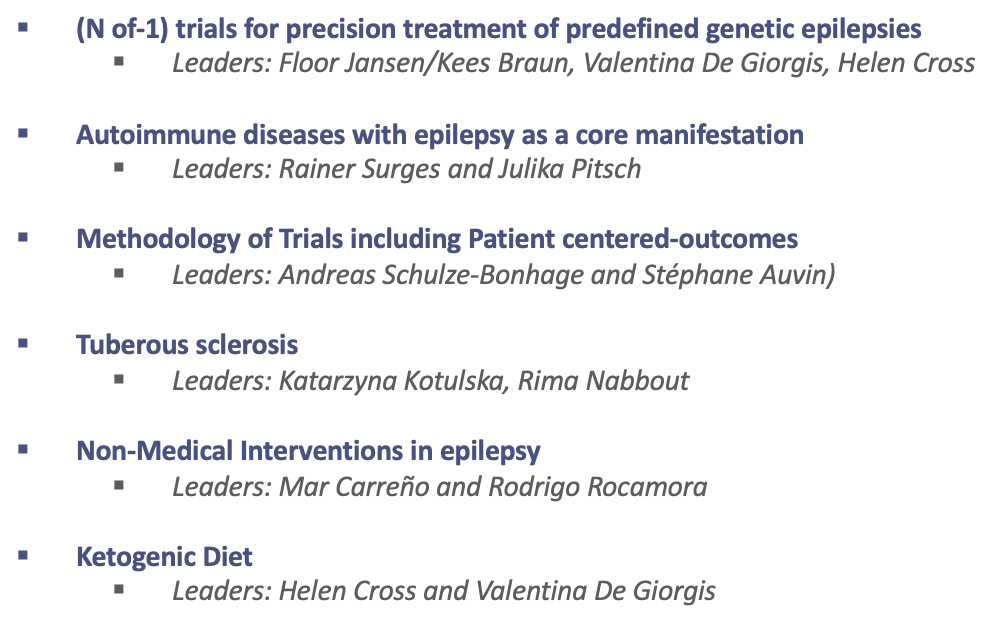
Recognition of the epilepsies as a group of rare diseases with known aetiologies give us insight as to the underlying mechanisms involved in both development of seizure-generating networks, as well as comorbidities such as cognitive, physical, emotional and behavioural disturbances. To improve study designs and choice of relevant interventions, there is a need to collect standardized data on outcomes associated with specific treatments such as anti-seizure medications, repurposed drugs targeting underlying mechanisms, disease-modifying treatments (including immunosuppression, treatments targeting protein and gene expression), and non- pharmacological treatments (such as diets, neurostimulation, and surgical therapies) or interventions (cognitive, behavioral and physical therapies) in people with rare and complex epilepsy. To foster advancements, special interest groups (SIG) for specific epilepsies (e.g. autoimmune epilepsies, tuberous sclerosis, etc), and with focus in specific aspects of trial design (e.g. n-of 1- methodology, use of PCOMs etc.) were established to identify the particular needs of an entity to enable conduction and ultimately performance of clinical trials. The goals of this working group are to support and review initiatives in identifying unmet needs, study development and designs, provide expertise by contributing to activities of the European Consortium for Epilepsy Trials (ECET), disseminate these initiatives and study results. We also contribute to educational initiatives to improve the knowledge of novel trial designs, analysis, and outcome measures.
If you wish to contribute to the work of a SIG or propose the creation of a new one, please use the contact form.
June 2025. Salzburg (Austria). Floor Jansen. Why performing clinical trials to evaluate new treatments is important? What are the benefits for the patients who accept to participate? What are the risks, compared to those related to their active drug-resistant epilepsy?
June 2025. Salzburg (Austria). Valentina De Giorgis. What motivated you to lead an EpiCARE project on issues related to transition of care from childhood and adolescence to adulthood? What are the main difficulties such programs are encountering? What could be the solutions and how can patient advocates help?
February 2020. Lyon (France). Rainer Surges.
If you are interested to voluntarily contribute to this WG activities, please use the contact form to let us know.